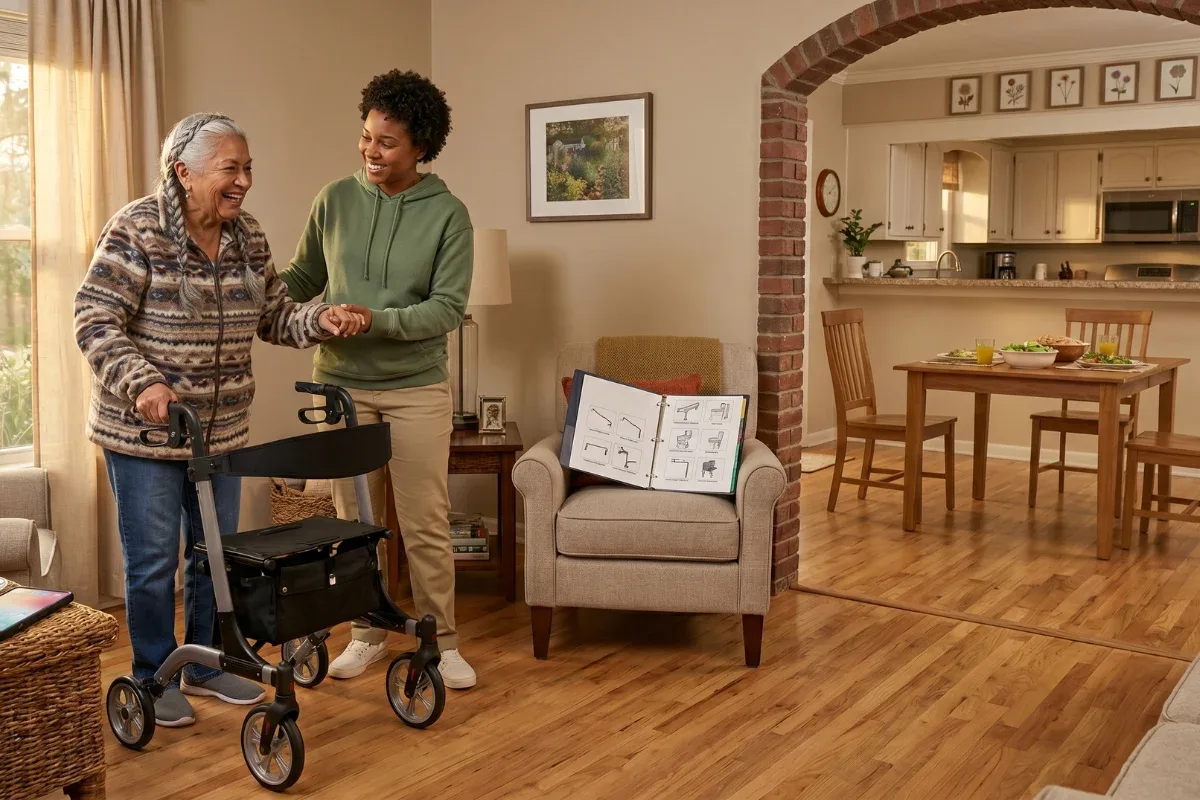
Mobility assistance for seniors includes the equipment, services, and hands-on help that keep seniors moving and aging safely at home. For older adults across central Arkansas, that support rarely looks like one thing. It is the grab bar someone thought to install last spring, the aide who shows up Tuesday and Thursday, the neighbor who just takes you to appointments now, no discussion needed. These arrangements, quiet and practical, add up to staying home instead of leaving it.
Key Takeaways
- Mobility assistance covers the equipment, services, and hands-on help that keep seniors moving safely at home.
- 75% of adults 50+ want to stay in their own homes as they age, yet mobility disability is the most common disability among adults 65+.
- Walking aids are used by 63.8% of mobility device users, making them far and away the most common form of support.
- Wall-grabbing, steering clear of stairs, quietly skipping outings you used to enjoy: these are the moments worth paying attention to.
- Something as simple as a grab bar or an entryway ramp can stop a fall before it ever happens.
- For central Arkansas families, CareLink offers home care, transportation, fitness programs, and caregiver support at no cost or low cost for those who qualify.
- Getting the right support is not about giving something up. It is about staying in control of your own life, on your own terms.
Jump To
The Truth About Aging in Place
Picture the afternoon light coming through the kitchen window. Coffee on the counter. The same worn path from the living room to the back porch where they’ve spent every summer evening for the last four decades.
That’s what home actually means. Not square footage, not a zip code. It’s the chair by the window, the creak on the third step, the coffee routine that hasn’t changed in thirty years. For a lot of older adults in central Arkansas, staying in that space is the whole point. And for most of them, some form of mobility support is what makes it possible.
If you’re not sure where to start yet, that’s okay. That’s what CareLink is here for. We’ve been alongside central Arkansas families since 1979, and we know that aging in place looks different for everyone.
The numbers help frame it. According to AARP’s Home and Community Preferences Survey (published Dec. 10, 2024), 75% of adults 50 and older want to stay in their homes as they age. Meanwhile, the CDC identifies mobility disability as the most common disability among adults 65 and older. That gap between what people want and what’s becoming harder to do: that’s exactly where the right support makes all the difference.
But statistics don’t tell the whole story. They don’t capture needing to get from the bedroom to the bathroom at 2 a.m. and not quite trusting your legs. They don’t capture watching someone you love grip the doorframe before taking that first step. Asking for help, or helping someone you love figure out how to ask, can feel like a threshold nobody’s ready to cross.
It doesn’t have to feel that way. Most families have far more options than they realize, and finding what fits usually just means knowing where to look.
Here’s a closer look at what’s actually available.
What Mobility Assistance Options Are Available for Seniors?
Most families don’t realize how many mobility assistance options exist until something happens and they’re suddenly scrambling. Walking aids, home modifications, transportation services, physical activity programs. Each one solves a different piece of the puzzle, and nobody hands you a guide. You piece it together from something a doctor mentioned in passing, or a neighbor who went through this the year before you did.
Here is a quick overview before we get into each one:
| Option | Best for | How to get started |
|---|---|---|
| Walking Aids | Seniors needing balance support or stability on the go | Talk to a primary care doctor or physical therapist for a recommendation |
| Home Modifications | Aging in place safely, reducing fall risk at home | Contact a local aging services agency or certified aging-in-place specialist (CAPS) |
| Transportation Assistance | Getting to appointments, errands, and social connections | Check with your local Area Agency on Aging or call 211 |
| Exercise/Physical Activity | Maintaining strength, balance, and flexibility | Join a senior center class, ask a physical therapist, or start with a simple walking routine |
Walking Aids
Canes and walkers are the most common form of mobility assistance, and the data reflects that clearly. A 2024 University of Pittsburgh study published in the Journal of Elder Policy found that 63.8% of mobility device users rely on walking aids. That makes sense when you think about what these tools actually do. Someone who needs a little extra steadiness on uneven ground will find that a cane handles it well. For longer distances or less predictable terrain, a walker or rollator earns its place.
What most people don’t expect is how much fit matters. A device that’s even slightly off in height doesn’t just feel uncomfortable; it can quietly make falls more likely, not less. One session with a physical therapist can save a lot of trial and error. And using a walking aid isn’t giving something up. It’s how someone stays on their own terms for longer.
Home Modifications
The home is often where mobility challenges first show themselves, and usually not through one dramatic event. It’s more like the bathroom feeling a little riskier than it used to, or the front steps getting harder to manage after dark. The fixes that make the biggest difference tend to be the unglamorous ones: grab bars near the toilet and tub, non-slip mats, better lighting in the hallway. Bigger projects matter too, things like ramps, stairlifts, and widened doorways, especially as needs change over time.
AARP’s December 2024 research found that 72% of adults 50 and older expect to need grab bars at home, and 71% anticipate needing entryway modifications. Most families aren’t surprised by those numbers. What catches them off guard is how long the gap stretches between knowing something is coming and actually doing something about it. That gap is usually right where a fall finds its opening.
Transportation Assistance
Moving safely inside the house is only part of what independence looks like. Getting out matters just as much. Medical appointments don’t reschedule themselves. Groceries don’t appear on their own. Staying connected to friends requires actually being able to reach them. For a lot of seniors, that’s where independence quietly starts to slip.
If your loved one is in the central Arkansas area, CareLink transportation helps eligible adults 60 and older get to medical appointments and essential errands, though availability can vary. More broadly, non-emergency medical transportation, volunteer driver programs, and coordinated transit options can fill those gaps depending on where someone lives. For seniors who struggle to leave home at all, CareLink’s homebound services bring support directly to them. Transportation gets overlooked in these conversations more than it should. Access to the outside world is a real part of what independence actually means.
Exercise and Physical Activity
Keeping the body moving is one of the most direct ways to protect mobility and lower fall risk. And yet it tends to be the first thing that drops off when life gets a little harder to manage.
The options are genuinely wide. Physical therapy, a daily walk around the block, balance and strength classes at a senior center, or CareLink’s Fitness and Wellness programs, including chair exercises for seniors who are working with more limited range. Whatever your loved one’s current ability level, something on that list fits.
These aren’t extras. They’re how people stay ahead of the problem. Seniors who hold onto independence the longest tend to be the ones who kept moving in the earlier stages, before a fall forced the issue.
Knowing what’s available is a solid start. The next section covers the specific warning signs worth watching for as you figure out where your loved one actually stands.
How to Know When a Senior Needs Mobility Assistance
It rarely announces itself. There’s no clear moment when everything shifts, just small things that start adding up. A route through the house that’s quietly changed. An activity dropped without explanation. A grip that lingers on the counter a beat longer than it used to.
What makes this hard isn’t the noticing. It’s the naming. The second-guessing. The guilt that comes with looking too closely, and the guilt that comes with looking away. Families wonder whether they’re overreacting, whether they’re seeing what they want to see, whether bringing it up will feel like a betrayal. All of that is real, and almost everyone goes through it.
What’s also real is that earlier usually means more options. Not a perfect solution, just more room to move, more time to make thoughtful choices instead of urgent ones. The sooner you look closely, the more you can do.
Warning Signs to Watch For
Picture this: someone holds the kitchen counter while pouring their morning coffee. They’ve done that routine for sixty years without thinking about it. You notice it once, then twice, but say nothing. Three months later, they fall getting out of the tub.
That counter grip was the first sign. It just didn’t look like one at the time.
Mobility decline rarely shows up as a problem. It arrives as small accommodations: a different route through the house, a steadying hand that wasn’t there before, a grocery trip that quietly stopped happening. None of it seems alarming on its own. But step back and look at the pattern, and the picture becomes clearer than any single moment could show you.
Some things worth paying attention to:
- Getting up from a chair takes multiple attempts, or requires bracing against the armrests, a wall, or another person
- Touching walls and counters while moving through spaces they’ve navigated for years without a second thought
- Avoiding the stairs entirely, or finding workarounds for things that used to be routine, not because they chose to, but because it became easier not to try
- Pulling back from walks, errands, or plans with friends. Often they won’t say why. They’ll find another reason.
- Falls that got minimized (“I just tripped”), or near-misses nobody mentioned until much later
- Running out of steam faster than before. A walk to the mailbox, a trip through the grocery store: tasks that never needed recovery time now do.
- Reluctance to go anywhere alone, particularly at night, on uneven ground, or somewhere unfamiliar
Two or three of these together calls for a real conversation and a concrete response. This week: look at bathroom safety (that’s where most falls happen), get a mobility evaluation scheduled with their doctor, and think through transportation options before a crisis forces the issue.
One thing worth understanding here: these aren’t purely physical signals. Research published in BMC Geriatrics (2023) confirms that mobility changes usually come from a mix of factors, including strength, balance, home setup, health changes, and the kind of confidence that can quietly erode after a near-fall. No single symptom tells the whole story.
When In-Home Support Makes Sense
When those signs start stacking up, home care is usually the most practical move, and one of the most effective ways to help someone stay in their own home longer. A personal care aide can help with movement, bathing, and the everyday tasks that have quietly become harder or less safe to manage alone. They’re also present during the moments that matter most: the ones that happen when no one else is around.
People don’t talk about this part enough, but the relationship itself does a lot of the work. A caregiver who shows up consistently, who actually learns how your loved one moves through their day and what they’d never think to ask for, builds something real. That kind of trust doesn’t happen overnight. When it does, though, it becomes just as important as the physical support. Sometimes more.
CareLink’s home care program connects central Arkansas seniors with exactly that kind of support. If the warning signs above feel familiar, the next section covers specific mobility assistance resources available close to home in central Arkansas.
Mobility Assistance Resources in central Arkansas
Forty-five years in central Arkansas. We’ve been here since 1979, six counties, showing up for seniors who just want to stay in their own homes. That’s the work. It hasn’t changed.
If anything in the warning signs section felt familiar, start with a call to our free Information and Assistance line. One conversation. We listen to what’s actually going on, and we figure out together what makes sense. Could be HomeCare. Could be something else. It depends on you and where you are.
We serve Faulkner, Lonoke, Monroe, Prairie, Pulaski, and Saline counties.
We’re not a national hotline. Nobody here passes you off to a referral database. One location, local staff, and when you call, you’re talking to someone who lives in the same region you do. New diagnosis, just home from the hospital, trying to hold onto a little more independence before the options narrow. Whatever brought you here, there’s a real chance we can help. For most people who qualify, cost isn’t the barrier they expect.
Service Area and Eligibility
- Serving central Arkansas: Pulaski, Faulkner, Lonoke, Monroe, Prairie, and Saline counties
- Many services available for adults 60 and older (eligibility varies by program)
- Call us or complete a contact form and we will guide you to the right fit
What the support looks like varies. Here’s some of what we do.
A lot of seniors don’t need round-the-clock care. They need someone there for the hard parts of the morning: bathing, getting dressed, moving around the house without worrying about the floor. That’s what HomeCare aides do. Those hours add up to something real over time.
Transportation exists because a doctor’s appointment shouldn’t become the logistics problem of someone’s week. It shouldn’t, but without help, it often does.
The Senior Centers aren’t just a place to go. Fitness and Wellness programming, people staying physically active and connected to other people. Turns out, that combination is one of the strongest predictors of holding onto mobility long-term. The research keeps pointing the same direction.
And for adult children managing a parent’s care from across town or across the state: the Family Caregiver Support Program isn’t a pamphlet. It’s actual guidance from people who know this territory and have helped a lot of families navigate it.
Call the free Information and Assistance line. Just tell us what’s going on. That conversation has a way of opening doors people didn’t know were there.
Still have questions about eligibility, how to get started, or what to expect? The next section covers the ones we hear most often.
Frequently Asked Questions
What does mobility assistance mean for seniors?
Depends on the person. That’s actually the whole point.
For one neighbor, a grab bar in the shower was enough. For the man next door, it’s a walker and a ride to appointments twice a week. Both of them are receiving mobility assistance. The form just looks completely different.
The common thread is closing the gap between where someone is and what they’re trying to do, getting out of the tub safely, making it to the grocery store, moving through the house without holding their breath. Independence doesn’t mean doing everything yourself. It means not being stopped by things that used to be manageable.
Does Medicare cover mobility assistance equipment?
Often yes, but with conditions worth knowing before you assume.
Medicare Part B covers durable medical equipment like walkers and wheelchairs when a doctor prescribes it and Medicare deems it medically necessary. That second part is where people get tripped up. “Medically necessary” has a specific meaning in Medicare’s world, and you’ll need a written prescription from an enrolled supplier to back it up.
Do yourself a favor: go straight to Medicare’s coverage page before anything else. Ten minutes there beats untangling a billing problem after the equipment is already sitting in your living room.
How do I know if my parent qualifies for CareLink services?
Most families are surprised. Eligibility is broader than people expect.
CareLink serves adults 60 and up across Pulaski, Faulkner, Lonoke, Monroe, Prairie, and Saline counties in central Arkansas. A lot of services are offered at no cost or on a sliding-fee scale, so cost isn’t a reason to avoid asking the question.
Call (501) 361-1047 or apply online. The Information and Assistance team will walk through what’s available and what actually fits the situation. That’s what they’re there for, no obligation to figure it out first on your own.
What is the difference between a walker and a rollator?
Same goal, different mechanics.
A standard walker is a four-legged frame you lift and set down with each step. No wheels, no moving parts, very stable. A rollator has wheels and hand brakes, so you push rather than lift. That sounds like a small difference until you’re covering any real distance, and then it isn’t small at all.
The catch: rolling requires a bit more balance than a planted frame does. Your doctor or physical therapist is the right person to sort out which one fits how you actually move through your day.
Can CareLink help with transportation to medical appointments?
Yes. CareLink’s non-emergency medical transportation program helps qualified seniors get to and from medical appointments when driving isn’t an option. A missed ride shouldn’t become a missed appointment. With this program, it doesn’t have to.
CareLink Is Here for Seniors Across central Arkansas
Here’s what we see happen: families notice the signs, tell themselves there’s time, and then one fall or one hospitalization makes the decision for them. Not because they didn’t care. Because it’s hard to know when to move, and it’s easy to believe things are still fine.
The grab bar that gets installed before the fall. The weekly check-in that catches something early. A few hours of help around the house that buys another year at home. Those things matter more than people realize, and they’re available before a crisis forces the issue.
If you or someone you love is starting to notice changes, you don’t have to figure this out alone. Reach out to CareLink today. We’ll listen, walk through what’s available, and help you find what actually makes sense for your situation, at whatever pace feels right for your family.